Teaching Through Problem-solving
In Teaching Through Problem-solving (TTP), students develop each new mathematical concept by solving a problem that illuminates it.
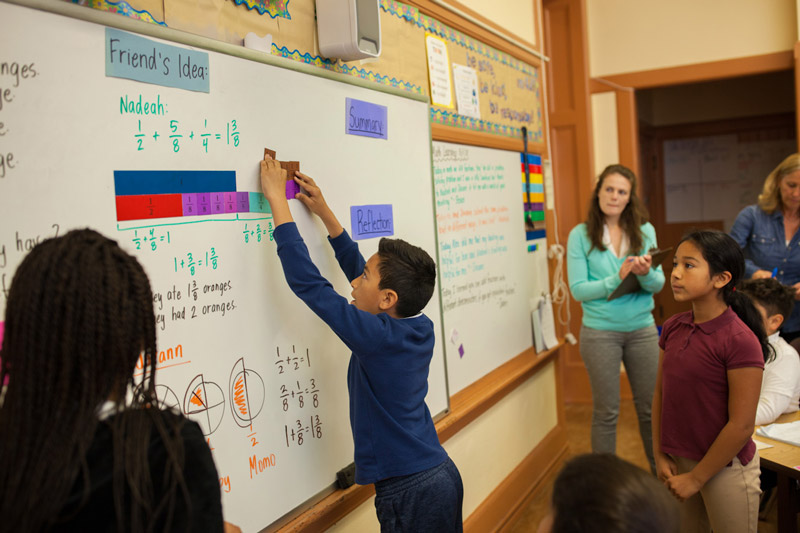
As a first-year teacher, trying TTP felt daunting because it’s clearly an advanced teaching methodology. Through the activities and practice-based learning days in this program, I got a deeper understanding of how to structure lessons and facilitate student learning. This experience gave me the confidence to put what I learned into my practice.
—Vanessa Zermeno
1st grade bilingual teacher, John Muir Elementary
A Guide to Build Teaching Through Problem-solving
The work can be broken up into segments that fit your available time, but the order should be maintained as you work through the three topics below. Topic 1 and Topic 2 are each suitable for a workshop of about 3-4 hours. Allowing some days or weeks in between the study of Topic 1 and Topic 2 will allow educators to try out TTP ideas in their classroom practice and bring back artifacts for Topic 3, Practice-based Learning Days. Practice-based Learning Days provide a model to continue to deepen practice, working within a teacher network. Ideally a schedule for recurring Practice-based Learning Days should be set up.
Topic 1: What is Teaching Through Problem-solving?
The 5 activities within Topic 1 explore the key characteristics of TTP and the phases of a TTP lesson. Examine video of each lesson phase and consider how it supports student agency and mathematical growth. Identify strategies you want to try in your own practice.
Additional materials for teams or professional learning facilitators:
Topic 2: Teaching Through Problem-solving Routines
Topic 2 focuses on TTP routines that make student thinking visible–including organized boardwork, reflective mathematics journals, and student-led discussion and summarization. Examine classroom videos to see how these routines support students’ mathematical reasoning, agency, understanding and metacognition. By the end of Topic 2, you should feel ready to dive into the TTP Practice-based Learning Day, the focus of Topic 3 .
Additional materials for small teams or professional learning facilitators:
Topic 3: Practice-based Learning Day
In Topic 3, teachers come together to plan, observe, and discuss student learning and their own teaching practice, drawing on evidence from a live TTP lesson. The lesson is typically planned and taught by a volunteering teacher who chooses the lesson content and goals (based on students’ current needs) and prepares a lesson plan based on anticipated student thinking.
A few days before the live TTP lesson, the group of teachers gather to conduct a “mock-up” rehearsal of the lesson, with teachers playing the role of students. After experiencing the lesson as “students,” teachers share ideas about how to make student thinking visible and about any anticipated challenges in the lesson.
On the Practice-based Learning Day, the TTP lesson is taught and discussed, allowing all participants to learn from the design and its enactment and to consider implications for future instruction.
If you are an individual doing self-study of the TTP guide, you will not have a ready-made group of colleagues for the Practice-based Learning Day. However, you might consider asking one or more colleagues to briefly review an element of the TTP materials you are working on in your classroom, to observe your lesson, and to gather data on student responses. Such experiences often nurture interest and future teamwork.
Additional materials for small teams or professional learning facilitators:

Topic 1: Slide-deck with video clips

Topic 1: Facilitation Agenda

Topic 2: TTP Lesson Planning Tool
Topic 2: Slide-deck with video clips
Topic 3: TTP Lesson Notecatcher

Topic 3: Mock Lesson Facilitation Agenda
